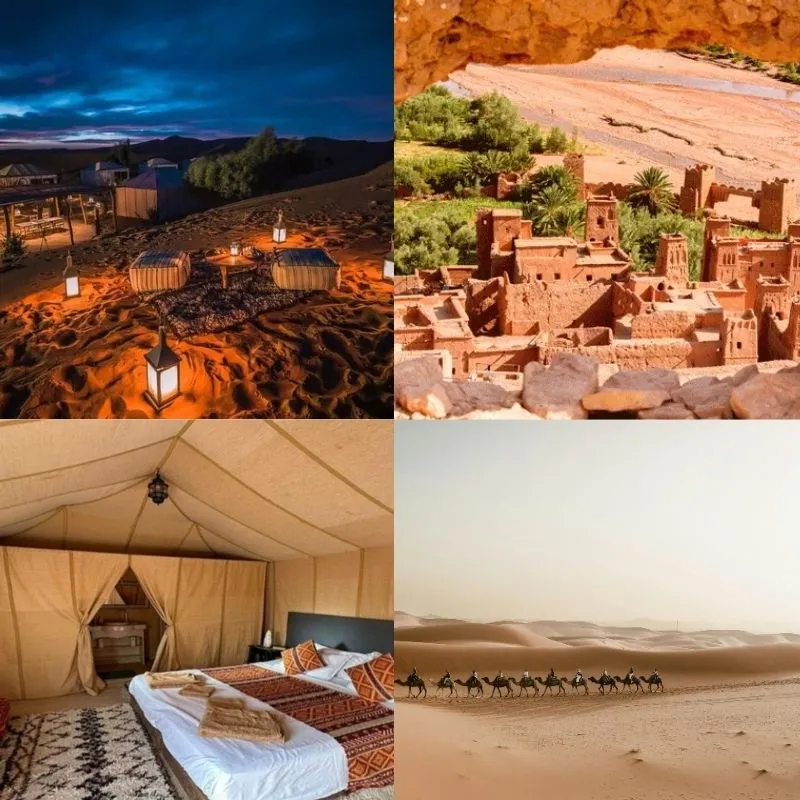
The Dades Valley unspools between Ouarzazate and the Todra Gorge along the famous Road of a Thousand Kasbahs — a ribbon of palm groves, rose fields and red-earth villages framed by the High Atlas and the Anti-Atlas. It is one of the most scenic stretches of any Morocco desert tour, and a natural overnight stop on the way to the Sahara.
The valley's showpiece is the Dades Gorge, where the river has carved dramatic cliffs and the road climbs in a series of hairpin switchbacks famously known as the 'monkey fingers'. Add surreal eroded rock formations, ancient kasbahs and the nearby Valley of Roses, and the Dades earns its place on every classic itinerary.
Top things to do in the Dades Valley
1. The Dades Gorge & hairpin road
The valley's signature sight — sheer red cliffs and the photogenic switchback road climbing out of the gorge, best at golden hour.
2. The 'monkey fingers' rock formations
Bizarre, finger-like eroded rock walls near Aït Oudinar — a short walk reveals their full strangeness.
3. The Valley of Roses
Near Kelaât M'Gouna, fields of Damask roses bloom each spring and are distilled into rosewater; the rose festival in May is a highlight.
4. Kasbahs of the valley
Crumbling earthen kasbahs dot the route — many can be visited, and some have become atmospheric guesthouses.
5. Walking among the palmeraies
Gentle walks through the riverside palm groves and Berber villages reveal everyday life away from the main road.
6. Kasbah Amridil in Skoura
West of the Dades, the restored Kasbah Amridil in the Skoura oasis is one of the best-preserved earthen fortresses in Morocco and appears on the 50-dirham banknote. It shows clearly how these buildings actually functioned — granaries, stables and living quarters stacked around a courtyard.
7. The Valley of Roses
Just north-west around Kelaat M'Gouna, damask roses are harvested at dawn each May and distilled into rosewater. The May festival is a working local celebration rather than a performance for visitors.
8. M'Goun trekking country
The Dades is the gateway to the M'Goun massif, Morocco's second-highest range. Multi-day treks run from the valley through remote Amazigh villages and gorges that see a fraction of Toubkal's traffic.
Best time to visit the Dades Valley
April and May are the finest months in the Dades: the valley floor is green, the almond and rose blossom is over or peaking, and daytime temperatures sit around 22–26°C. September and October are almost as good and quieter.
- Spring: the valley at its best. The rose harvest around Kelaat M'Gouna runs through May.
- Summer: hot by day, often above 35°C, though the river and palm shade keep the gorge itself cooler than the open plateau.
- Autumn: warm days, cold nights, excellent visibility — very good for walking.
- Winter: crisp and clear by day but genuinely cold after dark, and snow falls on the surrounding heights. Many valley guesthouses are only lightly heated.
Whatever the season, pack a warm layer for the evening — at around 1,500 m the temperature drops sharply once the sun leaves the gorge.
Getting to the Dades Valley
The Dades valley lies on the main Ouarzazate–Tinghir road, the artery travellers call the Road of a Thousand Kasbahs. Nearly every Marrakech-to-Merzouga itinerary overnights here, roughly halfway between the mountains and the dunes.
- Ouarzazate: about 110 km, roughly 1.5 hours
- Skoura oasis: about 70 km, roughly 1 hour
- Kelaat M'Gouna (Valley of Roses): about 25 km, roughly 30 minutes
- Todra Gorge: about 60 km, roughly 1 hour
- Merzouga: about 260 km, roughly 4 hours
- Marrakech: about 310 km, roughly 5.5 hours over the Tizi n'Tichka
The hairpin road — and how far to drive it
The switchbacks above Aït Oudinar are the valley's signature image, and the viewpoint café at the top of the bends is where nearly everyone stops. It is worth continuing beyond it: the road carries on north into the upper gorge, where the walls narrow, the traffic disappears and the valley becomes genuinely wild. Even 20 minutes further changes the experience completely.
Dades or Todra — which gorge?
They are an hour apart and quite different. Todra is the dramatic one: sheer 300 m walls closing to a narrow slot you can walk through in minutes, and Morocco's main rock-climbing venue. Dades is broader and more varied — the hairpins, the eroded "monkey fingers" rock formations, kasbahs and villages spread along a working valley. Todra is the better photograph; Dades is the better overnight. Most desert itineraries take in both, sleeping in the Dades and stopping at Todra the next morning.
Frequently asked questions
Is the Dades Valley worth stopping in?
Very much — it's one of the most scenic parts of the desert route, with the gorge, rock formations and kasbahs, and it breaks up the long drive to the Sahara perfectly.
What's the difference between the Dades and Todra gorges?
They're neighbours on the same route: the Dades is a broader valley with the famous switchback road, while the Todra is a narrow, sheer-walled canyon. Most tours visit both.
How long do you spend in the Dades Valley?
Usually an overnight, with time for the gorge and rock formations in the late afternoon and early morning before continuing east.
Is the Dades valley worth an overnight stop?
Yes — it is the standard and sensible overnight between Marrakech and Merzouga, and it breaks a very long drive. The gorge is at its best in early morning light before the day traffic arrives.
What are the "monkey fingers"?
A stretch of eroded rock formations in the valley whose rounded, finger-like columns give them the name. They sit right beside the road and take only a few minutes to see.
When is the rose harvest?
Through May around Kelaat M'Gouna, with picking at dawn while the oil content is highest. The rose festival is usually held in early May.
Dades or Todra Gorge — which is better?
Todra is more dramatic, with sheer 300 m walls and a narrow floor you can walk. Dades is broader and more varied, with the hairpin road and kasbahs. Most itineraries include both, as they are only an hour apart.
Can you hike in the Dades valley?
Yes, from short walks through the palmeraies and side canyons to multi-day treks into the M'Goun massif. Guesthouses in the valley can arrange local guides.

 Bestseller