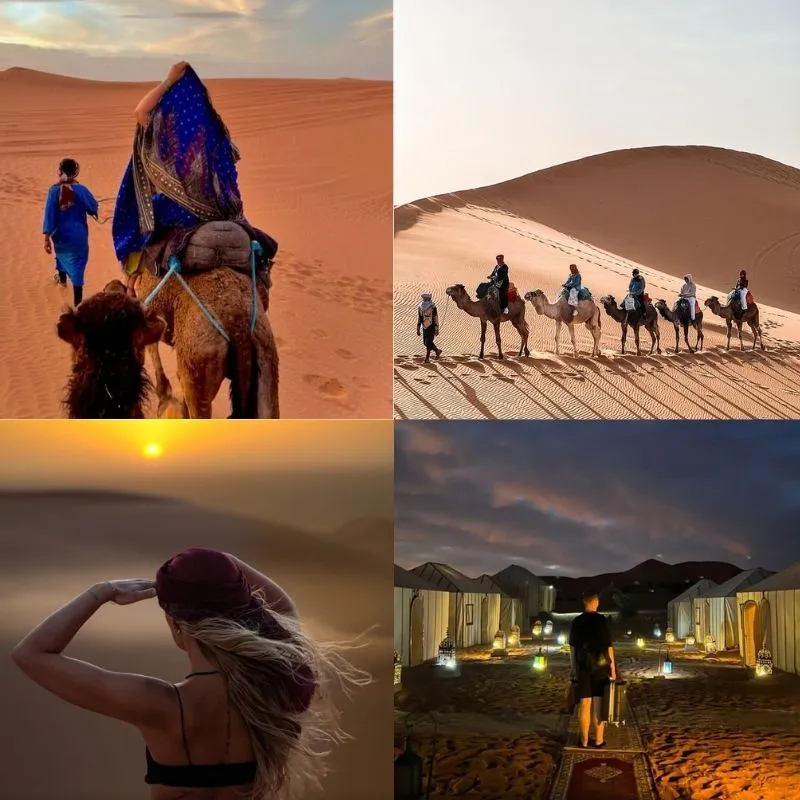
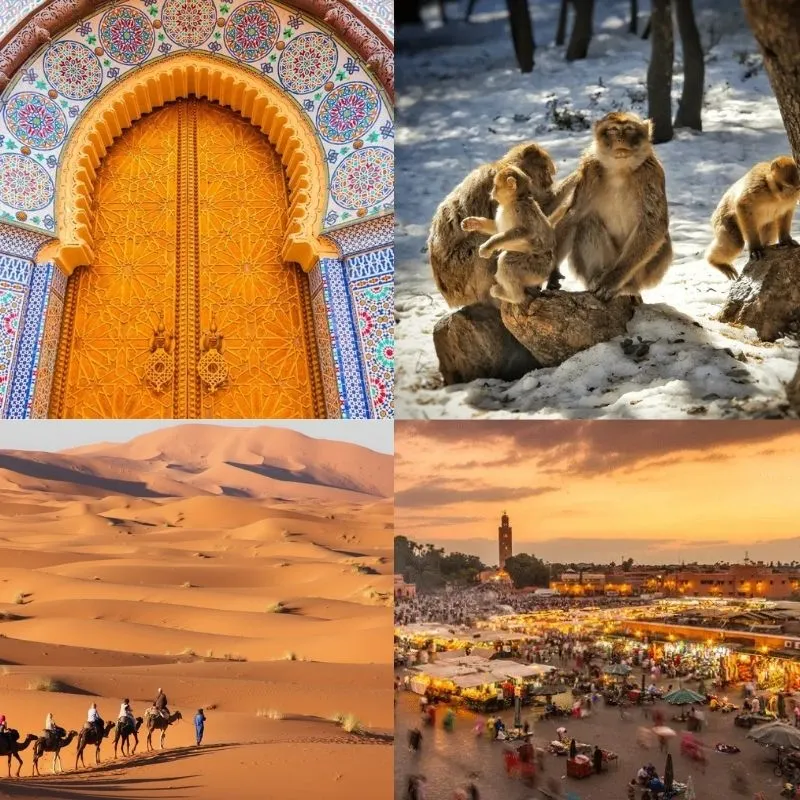
Merzouga is the gateway to Erg Chebbi, the towering sea of orange dunes that, for most travellers, is the Moroccan Sahara. Some dunes rise 150 metres, glowing from gold to deep amber as the sun moves, and at night the sky here — far from any city light — is simply staggering.
This small desert village exists for one reason: to launch you into the sand. By camel or 4x4 you cross into the dunes to a Berber camp, share a tagine and drumming around the fire, sleep under the Milky Way, and wake for a silent sunrise over the sand. It is the emotional high point of almost every Morocco trip.
Top things to do in Merzouga & the Sahara
1. Sunset camel trek
Ride a camel caravan into the dunes as the sand turns crimson — the classic, unmissable Sahara experience.
2. Overnight in a desert camp
Sleep in a Berber camp, from comfortable standard tents to luxury en-suite bivouacs with fine dining under the stars.
3. Stargazing & sunrise
With near-zero light pollution, the night sky is extraordinary; rise early for a magical sunrise over Erg Chebbi.
4. Quad biking & sandboarding
For adventure, tear across the dunes by quad or 4x4, or sandboard down the slopes.
5. Nomad & Gnawa culture
Visit a nomadic family for tea, or hear the hypnotic music of Khamlia's Gnawa musicians, descendants of sub-Saharan Africa.
6. Dayet Srji and the flamingos
The shallow salt lake west of Merzouga fills after substantial rain and then draws flamingos and migrating birds. In dry months it lies as a white salt pan — either way a worthwhile early-morning detour.
7. Rissani and the ruins of Sijilmassa
About 35 km away, Rissani is the cradle of the still-ruling Alaouite dynasty and holds one of the most genuine souks in southern Morocco (Sundays, Tuesdays and Thursdays). On its edge lie the remains of Sijilmassa, once the terminus of the trans-Saharan caravan routes.
8. Fossils around Erfoud
This region was seabed some 400 million years ago. Workshops in Erfoud still cut and polish trilobites and fossilised marine creatures out of the rock — one of the stranger sides of the Sahara.
Best time to visit Merzouga & the Sahara
The best time for Merzouga is October to November and March to April. Daytime temperatures then sit comfortably at 25–30°C, nights are cool without being freezing, and a camel ride over the dunes is manageable at any hour. July and August, at over 45°C, are too hot for most travellers.
- October–November: the most reliable window of all — warm days, clear nights, settled conditions.
- December–February: sunny days around 18–20°C but night temperatures near or below freezing. Camps provide blankets and fires; if you feel the cold, choose a luxury camp with solid walls. The winter night sky is the clearest of the year.
- March–May: warm and beautiful, though this is the main season for the Chergui — the hot desert wind that occasionally brings sandstorms and can cut visibility for a day or two.
- June–August: extremely hot, often above 45°C. Possible, but only with very early morning and late evening activity.
Whatever the season, temperatures fall sharply after sunset. Even in spring a jacket and long trousers are sensible for the evening.
Getting to Merzouga & the Sahara
Merzouga has no airport of its own; virtually everyone arrives overland, usually as part of a multi-day desert tour. The drive is part of the experience, crossing the High Atlas and running through the kasbah valleys.
- Marrakech: about 560 km via the Tizi n'Tichka pass, Ouarzazate and the Dades or Todra gorge. Allow three days minimum — one day is theoretically possible but exhausting and pointless.
- Fes: about 470 km via Ifrane, the Azrou cedar forest, Midelt and the Ziz valley — roughly 7 to 8 hours driving, normally split over two days.
- Ouarzazate: about 360 km, roughly 5 hours.
- Errachidia (ERH airport): about 120 km, roughly 2 hours — the fastest approach if flying internally.
- Rissani: 35 km · Erfoud: about 55 km.
Standard or luxury camp?
Both sit out in the dunes and both are reached by camel or 4x4. The difference is comfort, not location:
- Standard camp: goat-hair Berber tents, shared washing facilities, dinner and drumming around the fire. Simple, authentic and perfectly sufficient for most travellers.
- Luxury camp: solid-walled tents with private bathrooms, real beds, electricity and heating. Worth it in winter, with children, or if private facilities matter to you.
How many days do you need?
From Marrakech, three days is the sensible minimum: one day over the Atlas to Dades or Todra, one to the dunes with a camel ride and camp night, one to return. Four days is noticeably more relaxed — it gives you a full day in the desert rather than a single night, with time for Khamlia, Rissani and the nomad families. Anyone selling you Merzouga from Marrakech in two days is selling you a car journey.
What to pack
The desert asks for less kit than people expect, but a few things matter: warm layers for the night, even in summer; a scarf against sand and sun; sunglasses and sunscreen; closed shoes for the dunes; a power bank, since standard camps often have limited electricity; and cash, as card payment is rare in Merzouga. The nearest dependable ATMs are in Rissani and Erfoud.
Frequently asked questions
Merzouga or Zagora dunes — which is better?
Merzouga's Erg Chebbi dunes are far taller, more dramatic and more beautiful than the Zagora/Chegaga area's, and worth the extra driving for most travellers.
Is the camel trek comfortable?
It's an authentic experience rather than a luxurious one — about an hour each way. We can shorten it or arrange a 4x4 transfer for anyone who prefers.
What's the difference between a standard and luxury camp?
Standard camps have private tents with shared facilities; luxury camps offer en-suite bathrooms, proper beds and finer dining. We quote both.
How high are the dunes of Erg Chebbi?
The highest crests reach around 150 m. The erg is roughly 28 km long and 5 to 7 km wide — not an endless sand sea, but the most impressive dunes in Morocco.
Is the camel ride difficult?
The ride to camp usually takes 60 to 90 minutes and needs no experience. Mounting and dismounting is the awkward part. If you have back trouble or would rather not, you can be driven to camp by 4x4 instead — always an option.
Is there electricity and wifi at the desert camps?
Luxury camps generally have power and sometimes wifi. Standard camps usually run on solar with lanterns and limited charging. Mobile signal in the dunes is weak to non-existent — bring a power bank.
Merzouga or Zagora — which desert?
Merzouga has the genuine high sand dunes and is worth the extra drive. Zagora is closer to Marrakech but is mostly stone and gravel desert with much smaller dunes. If you picture the Sahara from photographs, Merzouga is the place.
Can you visit Merzouga with children?
Yes. The drive is long but can be broken into stages, and children can share a camel with a parent or travel to camp by 4x4. A luxury camp with private bathrooms makes the overnight considerably easier for families.

 Bestseller