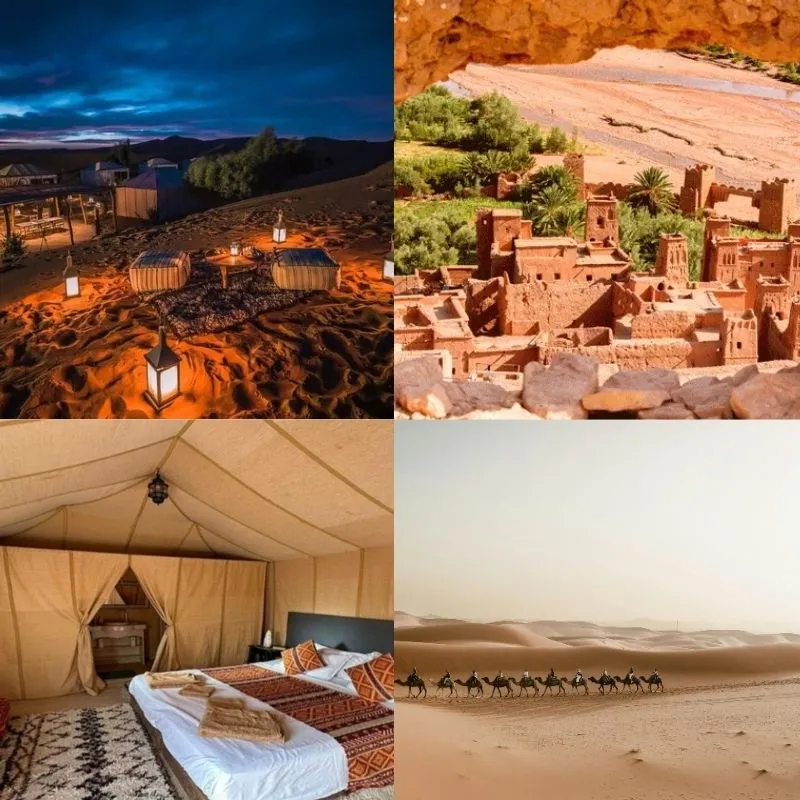
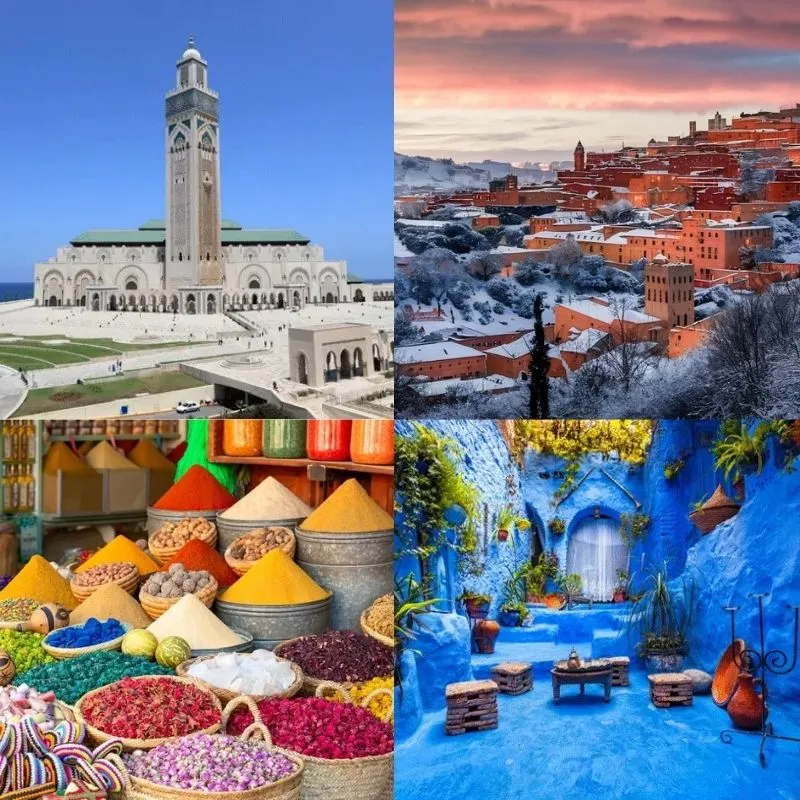
Marrakech, the 'Red City', is the beating heart of Moroccan tourism and the launch-pad for most desert journeys. Founded in 1070, this imperial city wraps a thousand years of history inside salmon-pink ramparts: a labyrinthine medina of souks and riads, serene palaces and gardens, and the theatrical nightly spectacle of Jemaa el-Fna square.
It is a city of contrasts — snake charmers and rooftop cocktail bars, donkey carts and designer boutiques — and it rewards both the first-timer ticking off icons and the returning traveller chasing hidden courtyards. Most visitors spend two to three days here before heading for the Atlas and the Sahara.
Top things to do in Marrakech
1. Jemaa el-Fna & the souks
The UNESCO-listed main square comes alive at dusk with food stalls, musicians and storytellers. By day, dive into the surrounding souks for lanterns, leather, carpets and spices — haggling expected.
2. Bahia Palace & the Saadian Tombs
The 19th-century Bahia Palace dazzles with carved cedar and zellij tilework, while the restored Saadian Tombs hold the city's most exquisite Islamic craftsmanship.
3. Majorelle & Le Jardin Secret
Yves Saint Laurent's cobalt-blue Majorelle Garden is Marrakech's most photographed spot; the Jardin Secret in the medina offers a quieter Islamic-garden retreat.
4. Koutoubia Mosque
The 12th-century minaret is the city's landmark and a model for the Giralda in Seville — best admired from the surrounding gardens at sunset.
5. Rooftop tea & a hammam
Climb to a medina rooftop for mint tea over the rooftops, then unwind in a traditional hammam — the Moroccan steam-and-scrub ritual.
6. El Badi Palace
Once among the most lavish palaces in the Islamic world, El Badi was stripped of its marble and onyx in the 17th century to build Meknes. What remains is a vast sunken ruin of bare walls and orange courtyards, now colonised by nesting storks — the opposite of the intricate interiors elsewhere in the city, and all the more striking for it.
7. The Ben Youssef Medersa
Reopened after a long restoration, the 16th-century Quranic school is the finest interior in the city — a courtyard of zellij tilework, carved cedar and stucco around a still reflecting pool. Go early; it is small and fills quickly.
8. The Mellah and the spice square
South of the palaces, the old Jewish quarter has a working spice and herb market, the restored Slat al-Azama synagogue and a large cemetery. It sees a fraction of the souk traffic and is one of the calmer corners of the medina.
9. The Agafay desert on the doorstep
Forty minutes from the city, Agafay is a stone desert of bare rolling hills rather than sand. It has become the standard half-day escape from Marrakech for camel rides, quad biking and sunset dinners when the Sahara is too far for your schedule.
Best time to visit Marrakech
The best months in Marrakech are March to May and September to November: warm days of 22–28°C and cool evenings, which is exactly what a city explored on foot demands.
- Spring (March–May): the finest window. Gardens are in flower and the Atlas still carries snow — the classic view of white peaks behind a warm city.
- Summer (June–August): regularly above 40°C and occasionally 45°C. Manageable if you treat the middle of the day as rest time and move at dawn and dusk, but it is genuinely demanding.
- Autumn (September–November): as good as spring, with warm evenings ideal for rooftop dining.
- Winter (December–February): mild sunny days around 18–20°C and cold nights. Riads are often only lightly heated, so pack a warm layer — but the light is superb and the crowds thin.
If you are combining Marrakech with the desert, note that the Sahara follows the same pattern: October to April is comfortable, midsummer is not.
Getting to Marrakech
Marrakech Menara Airport (RAK) sits about 6 km from the centre with direct flights from across Europe, which makes the city the most common entry point for a Moroccan trip. Trains link it to Casablanca in around three hours.
- Casablanca: about 240 km, roughly 2.5 hours by motorway or 3 hours by train
- Essaouira: about 175 km, roughly 2.5 hours
- Agadir: about 250 km, roughly 3 hours
- Ouarzazate: about 200 km over the Tizi n'Tichka, roughly 4 hours
- Merzouga (Sahara): about 560 km — properly done over three days, not one
- Imlil / High Atlas: about 65 km, roughly 1.5 hours
Where to stay: riad or hotel?
A riad inside the medina puts you within walking distance of the souks and Jemaa el-Fna, in a courtyard house that is usually cool, quiet and beautiful. The trade-off is that cars cannot reach most riads, so you walk the last stretch with your luggage, and the lanes are genuinely confusing at first. A hotel in Gueliz, the modern district, gives you vehicle access, wider streets and better restaurants for a change of pace, at the cost of a 10–15 minute taxi ride to the medina. First-time visitors usually prefer a riad; returning travellers often split their stay.
Handling the souks
The souks are the reason many people come and the reason some leave frustrated. Three things make them easier. Prices are negotiable and the opening figure is not the real one — counter at roughly half and settle in the middle, without rancour. Anyone who offers to lead you to a "special" workshop or tells you the square is closed is steering you towards a commission. And you will get lost, which is fine: keep heading downhill or ask a shopkeeper rather than a passing volunteer, and you will reach Jemaa el-Fna soon enough.
Frequently asked questions
How many days do you need in Marrakech?
Two to three days is enough to see the highlights and soak up the atmosphere before heading to the desert or the Atlas.
Is Marrakech safe?
Yes. The medina is busy and you'll be offered guiding and goods constantly, but serious crime against tourists is rare. A polite, firm 'no thank you' (la shukran) works well.
Where should I stay in Marrakech?
A riad — a traditional courtyard house — inside the medina is the classic choice for atmosphere; the Gueliz new town is quieter and more modern. We can recommend riads to suit your budget.
How many days do you need in Marrakech?
Three days covers the medina, the palaces, the gardens and a proper evening on Jemaa el-Fna without rushing. Add a day for the Atlas or Agafay, and more if you are heading to the desert.
Is Marrakech a good base for the Sahara?
It is the most common starting point. Merzouga is about 560 km away, so allow three days minimum — a day over the Atlas to Dades or Todra, a day to the dunes with a camel ride and camp night, and a day back. Two-day desert trips exist but are almost entirely driving.
Marrakech or Fes for a first visit?
Marrakech is livelier, easier to reach, better supplied with hotels and the practical base for desert tours. Fes has the older and more authentic medina and far fewer visitors. If you have time for only one and want excursions, choose Marrakech.
Is Marrakech safe?
Yes. It is a heavily visited city with a visible tourist police presence. The main irritations are persistent touts, unofficial "guides" and overcharging rather than crime — take normal precautions with valuables in crowded souks.
Is haggling expected in the souks?
Yes, in the souks it is the norm and part of the exchange. Fixed-price shops and cooperatives exist and are marked as such. Stay good-humoured — the opening price is a starting point, not an insult.

 Bestseller