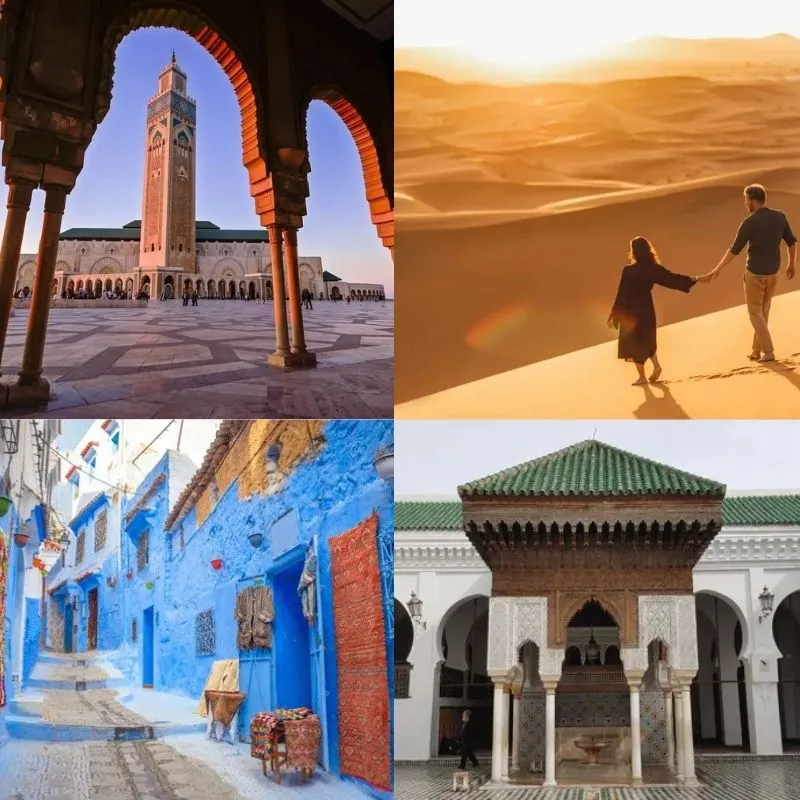
Tucked into the Rif Mountains of northern Morocco, Chefchaouen is the country's famous 'blue city' — a hillside maze of lanes, steps and houses washed in every shade of indigo and powder blue. It is small, relaxed and gloriously photogenic, a complete change of pace from the imperial cities.
Founded in 1471, 'Chaouen' was closed to outsiders for centuries. Today travellers come to wander its blue alleys, drink mint tea on quiet squares, hike to the Spanish Mosque for sunset, and simply slow down.
Top things to do in Chefchaouen
1. Wander the blue medina
The whole old town is the attraction — endless blue corners, flower pots and painted doors. Mornings are quietest for photos.
2. Plaza Uta el-Hammam & the Kasbah
The shaded main square and its red-walled 15th-century kasbah are the social heart of town.
3. Hike to the Spanish Mosque
A 30-minute uphill walk rewards you with the classic postcard view over the blue town at sunset.
4. Akchour waterfalls
A short drive away, the Akchour falls and 'God's Bridge' make a beautiful day hike in the Rif.
5. Shop for local crafts
Chefchaouen is known for wool blankets, goat cheese and handicrafts you won't find elsewhere.
6. Ras el-Maa and the old washhouse
At the top of the medina the Ras el-Maa stream emerges from the mountainside. Local women still wash clothes at the stone troughs here, and a handful of simple cafés sit right beside the water — the coolest spot in town on a hot afternoon.
7. A day trip to Tetouan
About 65 km north, Tetouan has a UNESCO-listed medina with a strong Andalusian character, built by refugees from Spain. It sees a fraction of Chefchaouen's visitors and makes an easy half-day trip on the way to or from Tangier.
8. Food from the Rif
The mountains around Chefchaouen produce goat cheese, mountain honey and olives you will not find further south. Look for fresh goat cheese served with bread and honey at the cafés on Plaza Uta el-Hammam — a genuinely regional breakfast rather than a tourist menu.
Best time to visit Chefchaouen
The best time to visit Chefchaouen is April to June and September to October. The town sits at about 600 m in the Rif mountains, which makes it noticeably cooler than lowland Morocco — pleasant in summer, genuinely chilly in winter.
- Spring: the hillsides are green and the Akchour waterfalls are running strongly — the best season for walking.
- Summer: warm but bearable thanks to the altitude. It is also the busiest time, especially at weekends.
- Autumn: mild and quieter, with clear views across the Rif.
- Winter: cool, often wet, and snow occasionally falls on the surrounding peaks. In exchange you get the blue lanes almost to yourself.
For photographs, the blue reads most intensely in the soft light of early morning — and before nine the famous lanes are still nearly empty.
Getting to Chefchaouen
Chefchaouen has no airport and no railway — everyone arrives by road, usually from Tangier or Fes. The drive through the Rif is winding but scenic.
- Tangier: about 110 km, roughly 2 hours — the shortest approach
- Tetouan: about 65 km, roughly 1 hour
- Fes: about 200 km, roughly 4 hours, often combined with a stop at Volubilis or Meknes
- Akchour (for the walk): about 30 km, roughly 45 minutes
Why is Chefchaouen blue?
There is no single agreed answer, which is part of what makes the question interesting. The most repeated explanation credits Jewish refugees who arrived in the 1930s and used blue as a spiritual colour. Other explanations are practical: that blue deters mosquitoes, or keeps the houses cool. And part of the truth is simply that the town now lives on the image, so the blue is regularly refreshed. What is documented is that the lanes were not always blue — older photographs show mostly whitewashed walls with blue accents.
How long to stay
Many people come as a day trip from Tangier or Fes. That works, but it means seeing the town at exactly the hours everyone else does. Staying a night changes the visit completely: you get sunset from the Spanish Mosque and the lanes at first light, when only residents are about. Two nights is worth it if you want to add the Akchour walk.
Frequently asked questions
Why is Chefchaouen blue?
Theories range from keeping mosquitoes away to a Jewish tradition symbolising sky and heaven, to simply attracting visitors — most likely a mix. Whatever the reason, it's magical.
Is one day enough for Chefchaouen?
You can see the highlights in a day, but an overnight lets you enjoy the quiet early-morning and evening light when day-trippers have gone.
Can I visit Chefchaouen from Fes?
Yes — it's a long day trip, but far better as an overnight on the way to or from Tangier or the north.
Is Chefchaouen worth a day trip?
It is doable — about two hours each way from Tangier, four from Fes. We recommend staying overnight though: the town is at its best at sunrise and sunset, and those are precisely the hours a day visitor misses.
Is Chefchaouen very touristy?
The main lanes around Plaza Uta el-Hammam are, during the day. A few minutes uphill it quietens immediately, and outside the core hours of 11am to 4pm the town feels like an ordinary Rif hill town again.
How hard is the walk to the Akchour waterfalls?
The lower waterfall is about two hours return on a well-used path. The big waterfall and the God's Bridge rock arch need four to five hours and proper shoes. Water levels are highest in spring.
Is Chefchaouen safe for solo female travellers?
Yes — it is regarded as one of the most relaxed towns in Morocco, with noticeably less hassle than the big cities. Normal precautions still apply, particularly on remote hiking trails.
What should you buy in Chefchaouen?
The region is known for wool blankets, woven textiles and Rif goat cheese. Prices are lower than in Fes or Marrakech and the sales pressure is far gentler.

 Imperial Cities