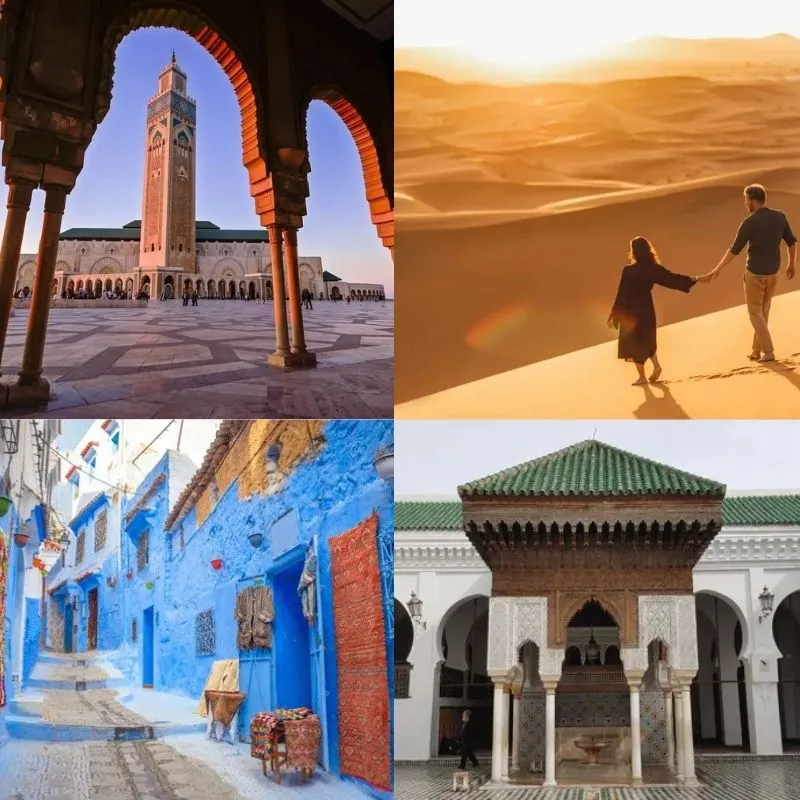
Rabat, the political capital of Morocco, is the most relaxed and orderly of the imperial cities — a UNESCO World Heritage site of broad boulevards, royal gardens, Atlantic ramparts and a refreshing absence of hard-sell tourism. It blends a tidy modern administrative quarter with a beautiful, walkable medina and some of the country's finest historic monuments.
Often overlooked by travellers racing between Fes and Marrakech, Rabat rewards a half-day or overnight, and slots naturally into northern and grand-tour routes between Casablanca, Tangier and Fes.
Top things to do in Rabat
1. Kasbah des Oudaias
A serene blue-and-white kasbah above the river mouth, with an Andalusian garden, café terraces and views over the Atlantic — Rabat's most charming corner.
2. Hassan Tower & Mausoleum of Mohammed V
The unfinished 12th-century minaret stands beside a forest of columns and the exquisite royal mausoleum, Rabat's defining landmark.
3. The Chellah
A romantic walled necropolis built over a Roman city, now overgrown with gardens and home to nesting storks.
4. The medina & Rue des Consuls
Compact, friendly and easy to navigate, with carpets and crafts sold without the pressure of the bigger cities.
5. Royal palace & gardens
The grand Mechouar quarter and the city's green spaces reflect Rabat's role as the dignified seat of government.
6. The Mohammed VI Museum of Modern Art
Opened in 2014, this was Morocco's first major museum of modern and contemporary art and shows international touring exhibitions alongside Moroccan work — a counterpoint to the city's historic sites.
7. Salé across the river
Facing Rabat is Salé, in the 17th century home to the notorious corsair republic of the Salé Rovers. It is markedly more traditional than the capital, has a fine 14th-century medersa, and is a few minutes away by tram.
8. The Bou Regreg waterfront
The riverbank between Rabat and Salé has been extensively redeveloped in recent years, with a marina, promenades and cafés looking across to the kasbah. A good spot for late afternoon, when the kasbah walls glow in the low light.
Best time to visit Rabat
Rabat is pleasant all year. As an Atlantic city it stays cooler than the interior in summer and milder than the mountains in winter. It is at its best from April to June and September to November.
- Spring: the kasbah gardens and the Chellah are green and full of the storks that nest there — the most photogenic time of year.
- Summer: warm at 26–28°C and comfortable thanks to the sea breeze; considerably more agreeable than Marrakech or Fes.
- Autumn: warm, clear and quiet.
- Winter: mild around 17°C, with rain most likely between December and February.
Getting to Rabat
Rabat sits on the central coastal corridor and is among the easiest cities in Morocco to reach. The Al Boraq high-speed train stops at Rabat Agdal; Rabat-Salé airport (RBA) serves some European destinations, though most long-haul travellers land in Casablanca.
- Casablanca: about 90 km, roughly 1 hour by car or 50 minutes by train
- Tangier: about 250 km — just over 1 hour on Al Boraq
- Meknes: about 140 km, roughly 1.5 hours
- Fes: about 200 km, roughly 2.5 hours
- Mohammed V airport (Casablanca): about 90 km, roughly 1 hour
The most relaxed of the imperial cities
Rabat is the capital but not a frantic one, and that is precisely its appeal. The medina is small and free of sales pressure, the streets are wide, there is a modern tram and a great deal of greenery. Travellers arriving from Marrakech or Fes, where they were approached constantly, often find Rabat a relief. UNESCO inscribed the city in 2012 as "Rabat, Modern Capital and Historic City" — explicitly for the way Islamic history and protectorate-era architecture sit side by side.
The Chellah — Romans, Merinids and storks
The Chellah outside the walls is Rabat's strangest site: first the Roman settlement of Sala Colonia, later a 14th-century Merinid necropolis, and today an overgrown tangle of ruins, fig trees and bougainvillea. Storks nest on the minarets and you hear their bill-clattering long before you arrive. Come in late afternoon, when the light is low and the site nearly empty.
Frequently asked questions
Is Rabat worth visiting?
Yes — as the calm, elegant capital it offers the Kasbah des Oudaias, Hassan Tower and the Chellah with far less hassle than Fes or Marrakech, ideal for a relaxed half-day or overnight.
Is Rabat one of Morocco's imperial cities?
Yes — Rabat is one of the four imperial cities, alongside Marrakech, Fes and Meknes, and is the current capital of Morocco.
Can Rabat be added to my Morocco tour?
Easily — it sits between Casablanca and the north, and we include it on grand tours and northern routes on request.
Is Rabat worth a stop?
Yes, particularly on a northern route. The Kasbah des Oudaias, the Hassan Tower and the Chellah combine well into a single day, and the city is far more relaxed than Marrakech or Fes.
How many days do you need in Rabat?
One full day covers the principal sites. With the modern art museum, a detour to Salé and an evening at the marina you can fill two comfortably.
What is the Chellah?
A ruin site outside the city walls: first the Roman town of Sala Colonia, later a 14th-century Merinid necropolis. It is now heavily overgrown and known for its nesting storks.
Can you visit the Royal Palace?
No — it is a working seat of government and closed to visitors. You can drive through the grounds to the outer gate and see the complex from outside.
Rabat or Casablanca — which is the better stop?
Rabat is considerably more rewarding for visitors: more history, a pleasanter old town and calmer streets. Casablanca has the Hassan II Mosque and the main airport. Many routes include both, as they are only an hour apart.

 Imperial Cities