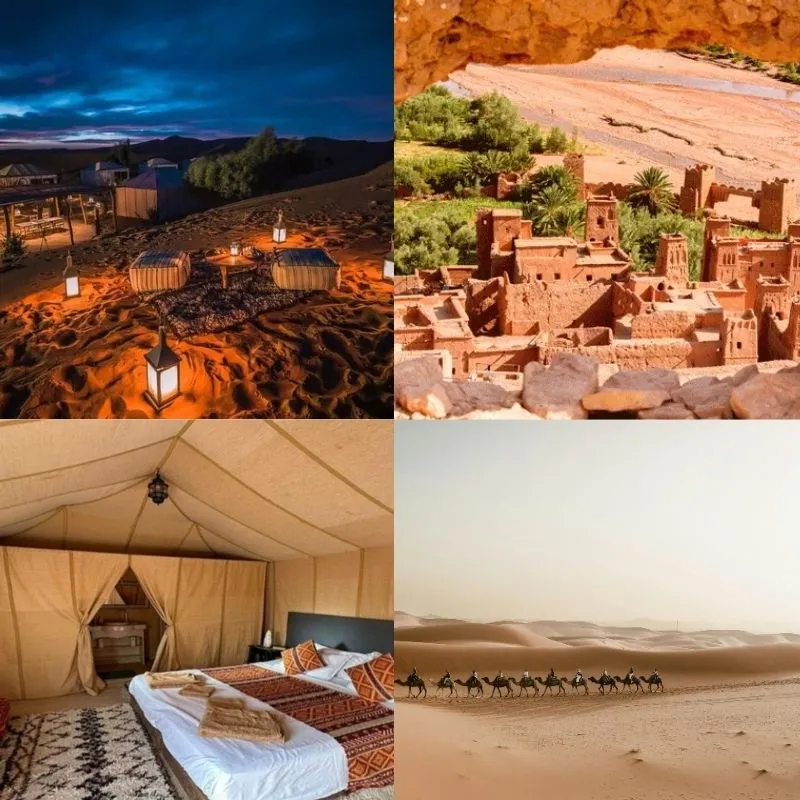
Known as the 'door of the desert', Ouarzazate sits just south of the High Atlas where the roads to the Sahara, the Draa Valley and the Dades gorges meet. Its earthen kasbahs, vast skies and cinematic landscapes have made it Morocco's film capital — Lawrence of Arabia, Gladiator, Game of Thrones and many more were shot in and around the town.
For travellers, Ouarzazate is both a destination and a crossroads: a base for the UNESCO-listed Aït Ben Haddou and the Atlas film studios, and the gateway through which nearly every Marrakech-to-Sahara tour passes.
Top things to do in Ouarzazate
1. Aït Ben Haddou
Half an hour away, this UNESCO-listed fortified village of stacked kasbahs is one of Morocco's most spectacular sights and a legendary film location.
2. Taourirt Kasbah
The grand 19th-century kasbah of the Glaoui clan, in the heart of Ouarzazate, with a warren of richly decorated rooms to explore.
3. Atlas & CLA Film Studios
Tour the sets and props of one of the world's largest film studios, where Hollywood and beyond have recreated ancient Rome, Egypt and Tibet.
4. The Draa Valley
South of town, the longest river in Morocco threads a 200 km ribbon of palm groves and kasbahs toward the dunes of Zagora.
5. Fint Oasis
A hidden green oasis just outside Ouarzazate, a tranquil contrast to the surrounding desert and a favourite of photographers.
6. The Skoura palm grove
About 40 km east, Skoura is a dense working oasis rather than a monument — kasbahs half-buried in palms, irrigation channels still in use, and the restored Kasbah Amridil, which appears on the 50-dirham note.
7. The Tizi n'Tichka pass
The road north to Marrakech climbs to 2,260 m through switchbacks and Berber villages. It is the classic approach to Ouarzazate and worth the stops; heavy winter snow can close it briefly.
8. The Valley of Roses
North-east towards Kelaat M'Gouna the valley fills with damask roses, harvested at dawn each May and distilled into rosewater. The festival in early May is a genuine local event rather than a staged one.
Best time to visit Ouarzazate
The best months for Ouarzazate are March to May and September to November, with warm days around 22–28°C and cool, clear nights. This is high desert at roughly 1,150 m, so the daily temperature swing is large all year.
- Spring: the finest window — the valleys are green, the Valley of Roses blooms in May, and the light is excellent for Aït Ben Haddou.
- Summer (June–August): regularly above 40°C. Bearable if you visit the kasbahs early and rest in the middle of the day.
- Autumn: warm, stable and quieter than spring — very good for photography.
- Winter: mild by day at 16–18°C but genuinely cold after dark, occasionally near freezing. Skies are at their clearest.
For Aït Ben Haddou, arrive early or late: the mud-brick walls turn deep ochre in low sun, and the coach parties come in the middle of the day.
Getting to Ouarzazate
Ouarzazate is the gateway between the High Atlas and the desert, and almost every Marrakech-to-Sahara route passes through it. It has a small airport (OZZ) with domestic and a few European flights, but most travellers arrive by road over the Tizi n'Tichka.
- Marrakech: about 200 km over the Tizi n'Tichka, roughly 4 hours with stops
- Aït Ben Haddou: about 30 km, roughly 30 minutes
- Skoura: about 40 km, roughly 40 minutes
- Dades Valley: about 110 km, roughly 1.5 hours
- Merzouga: about 360 km, roughly 5 hours
- Zagora (via the Draa valley): about 160 km, roughly 2.5 hours
Why Ouarzazate became Morocco's film capital
The combination of reliable light, dramatic desert landscape and low costs drew film crews here from the 1960s onward. Atlas Studios and CLA Studios have stood in for ancient Rome, Egypt, Tibet and Jerusalem — Lawrence of Arabia, Gladiator, Kingdom of Heaven and Game of Thrones all shot in the area. The studios are open to visitors, though be clear about what they are: standing sets of plywood and plaster, interesting for the craft rather than as monuments.
Aït Ben Haddou — what to expect
The ksar is a UNESCO World Heritage Site and Morocco's most photographed earthen village. A handful of families still live inside; most residents moved to the modern village across the river decades ago. Crossing the riverbed takes a few minutes, and the climb to the granary at the top is steep but short, with the best view over the valley. Allow around two hours.
Frequently asked questions
What was filmed in Ouarzazate?
Lawrence of Arabia, Gladiator, Kingdom of Heaven, Game of Thrones, The Mummy and many more — the studios and nearby Aït Ben Haddou are world-famous locations.
How far is Ouarzazate from Marrakech?
About 4 hours by road over the scenic Tizi n'Tichka pass through the High Atlas — a highlight of the journey in itself.
Is Ouarzazate a good base for the desert?
Yes — it's the gateway to Aït Ben Haddou, the Draa Valley and the Dades and Todra gorges on the way to the Erg Chebbi dunes.
Is Ouarzazate worth an overnight stay?
Yes, if you want to see Aït Ben Haddou in early or late light rather than at midday. As a base it also puts Skoura, the Draa valley and the film studios within easy reach.
How far is Aït Ben Haddou from Ouarzazate?
About 30 km, roughly 30 minutes by road. Most Marrakech-to-desert tours stop there on the way through.
Can you visit the film studios?
Yes, both Atlas Studios and CLA Studios run tours. They are standing sets rather than historic buildings, so treat them as an insight into film-making rather than a heritage site.
Is Ouarzazate a good base for the desert?
It is the natural staging post between Marrakech and the Sahara, but Merzouga is still about five hours further east. Most itineraries overnight in Ouarzazate or the Dades valley and reach the dunes the following day.
What does the name mean?
It comes from Amazigh and is usually translated as "without noise" or "no confusion" — a fair description of the town outside of film-crew season.

 Bestseller