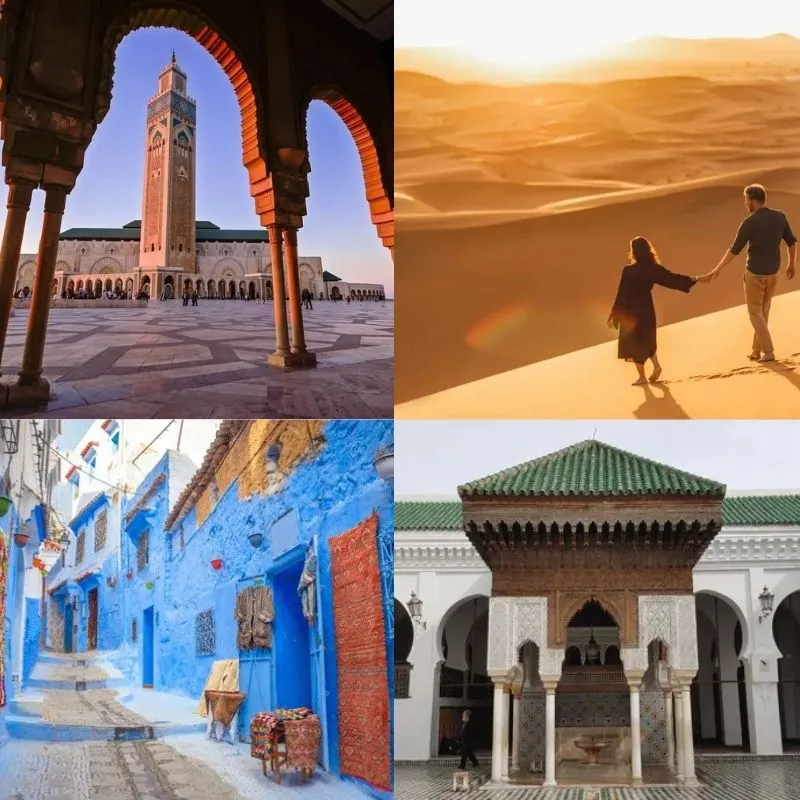
Casablanca is Morocco's largest city, its economic engine and the gateway through which most international flights arrive. More modern and cosmopolitan than the imperial cities, 'Casa' blends French Art Deco boulevards, a buzzing Atlantic Corniche and the staggering Hassan II Mosque — one of the largest mosques in the world and the only one in Morocco non-Muslims may enter.
While many travellers simply transit through, Casablanca rewards a day's exploration before heading south or to the imperial cities. It's also the most common starting point for grand Morocco tours, and our drivers collect you straight from Mohammed V Airport.
Top things to do in Casablanca
1. Hassan II Mosque
The city's masterpiece — built partly over the Atlantic, with a 210 m minaret and room for 105,000 worshippers. Guided interior visits run several times a day and are unmissable.
2. The Corniche & Ain Diab
Casablanca's seafront promenade is lined with cafés, pools and restaurants — the place to feel the city's modern, easy-going side.
3. Art Deco & Mauresque architecture
The centre around Place Mohammed V is an open-air museum of 1920s–30s French-colonial Art Deco, a style found almost nowhere else in Africa.
4. The old medina & Habous quarter
Smaller than Fes or Marrakech, Casablanca's medina and the elegant 'new medina' of Habous are great for olives, pastries and crafts without the hard sell.
5. Rick's Café
A loving recreation of the bar from the film Casablanca — touristy but atmospheric, and a fun evening stop.
6. Sacré-Cœur Cathedral
Built between 1930 and 1952 and long since deconsecrated, the cathedral now serves as an events space. Its white Art Deco facade and twin towers make it one of the most unusual buildings in Morocco — a relic of the French protectorate standing in the middle of the city.
7. The Museum of Moroccan Judaism
Opened in 1997, this is the only Jewish museum in the Arab world, telling the story of a community that helped shape Morocco over two millennia. Small, quiet and more illuminating about the country than most of what else Casablanca offers.
8. A day trip to El Jadida
About 100 km south lies the Portuguese fortress town of El Jadida and its UNESCO-listed 16th-century cistern — an underground vault whose film of water mirrors the columns. Orson Welles shot scenes for his Othello here.
Best time to visit Casablanca
Casablanca can be visited at any time of year. The Atlantic keeps temperatures within a narrow band: rarely above 28°C in summer, seldom below 8°C in winter. The most pleasant months are April to June and September to November.
- Spring and autumn: clear warm days around 22–26°C — ideal for the Corniche and the mosque.
- Summer: warm but bearable thanks to the sea breeze; the Ain Diab beaches are at their liveliest.
- Winter: mild, with most rainy days falling between November and February. The city functions exactly as normal, but pack an umbrella.
Coastal fog often sits over the city in the morning and burns off by midday — the norm on this coast rather than bad weather.
Getting to Casablanca
Mohammed V International Airport (CMN), about 30 km south of the city, is Morocco's main hub and for many travellers the first contact with the country. A direct train links the airport with Casa-Voyageurs station. Casablanca is also the southern terminus of the Al Boraq high-speed line.
- Rabat: about 90 km, roughly 1 hour by car or 50 minutes by train
- El Jadida: about 100 km, roughly 1.5 hours
- Marrakech: about 240 km, roughly 2.5 hours by motorway
- Tangier: about 340 km — just over 2 hours on Al Boraq
- Fes: about 290 km, roughly 3.5 hours
How much time does Casablanca need?
Honestly: Casablanca is Morocco's commercial capital, not a postcard city. If you have come purely for medinas and souks, Fes and Marrakech serve you better. For the Hassan II Mosque, the Corniche and a walk through the Art Deco districts, one full day is enough. It works excellently as the opening or closing stop of a tour, because most long-haul flights land here — but rarely as a destination in its own right.
Visiting the Hassan II Mosque
This is one of the very few mosques in Morocco that non-Muslims may enter — and the real reason to stop in Casablanca. Entry is by guided tour only, running several times daily in a number of languages, with reduced hours on Fridays. The minaret stands 210 m tall, part of the prayer hall extends over the Atlantic, and sections of the floor can be finished in glass so you can see the water beneath. Dress modestly and allow about an hour.
Frequently asked questions
Can non-Muslims enter the Hassan II Mosque?
Yes — it is one of the very few mosques in Morocco open to non-Muslims, via guided tours scheduled throughout the day (closed during prayer times).
Is Casablanca worth visiting?
For a day, yes — chiefly for the Hassan II Mosque, the Corniche and the Art Deco centre. Most travellers use it as an arrival point and start their tour here.
Can my Morocco tour start in Casablanca?
Absolutely. Many of our grand tours begin in Casablanca; we meet you at the airport and tailor the route from there.
Is Casablanca worth visiting at all?
For a day, yes — chiefly for the Hassan II Mosque, which as a non-Muslim you can see from the inside, and for the Art Deco architecture. As a multi-day destination it is less rewarding than Fes or Marrakech.
Can you go inside the Hassan II Mosque?
Yes, on a guided tour offered several times a day in several languages. Hours are restricted on Fridays. Modest dress is required.
How do you get from Mohammed V airport into the city?
A direct train runs to Casa-Voyageurs station in about 40 minutes. By car it is roughly 30 to 45 minutes depending on traffic. Our tours collect you at the terminal.
Is there really a Rick's Café in Casablanca?
There is, but it has no connection to the film — the 1942 classic was shot entirely in Hollywood. The restaurant opened in 2004 as an affectionate homage. A pleasant evening, not a historic site.
Is Casablanca a good starting point for a tour?
A very good one. Most long-haul flights land here, and from Casablanca you reach Rabat in an hour, Marrakech in two and a half and Fes in three and a half.

 Imperial Cities